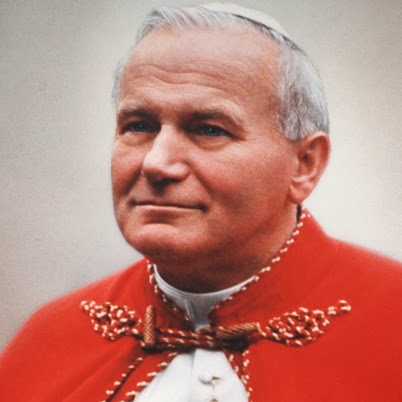
On July 4, 1958, he was appointed titular bishop of Ombi and
auxiliary of Krakow by Pope Pius XII, and was consecrated September
28, 1958, in Wawel Cathedral, Krakow, by Archbishop Eugeniusz
Baziak.
On January 13, 1964, he was appointed archbishop of Krakow by Pope
Paul VI, who made him a cardinal June 26, 1967 with the title of S.
Cesareo in Palatio of the order of deacons, later elevated pro illa
vice to the order of priests.
Besides taking part in Vatican Council II (1962-1965) where he made
an important contribution to drafting the Constitution Gaudium et
spes, Cardinal Wojtyła participated in all the assemblies of the
Synod of Bishops.
The Cardinals elected him Pope at the Conclave of 16 October 1978,
and he took the name of John Paul II. On 22 October, the Lord's Day,
he solemnly inaugurated his Petrine ministry as the 263rd successor
to the Apostle. His pontificate, one of the longest in the history
of the Church, lasted nearly 27 years.
Driven by his pastoral solicitude for all Churches and by a sense of
openness and charity to the entire human race, John Paul II
exercised the Petrine ministry with a tireless missionary spirit,
dedicating it all his energy. He made 104 pastoral visits outside
Italy and 146 within Italy. As bishop of Rome he visited 317 of the
city's 333 parishes.
He had more meetings than any of his predecessors with the People of
God and the leaders of Nations. More than 17,600,000 pilgrims
participated in the General Audiences held on Wednesdays (more than
1160), not counting other special audiences and religious ceremonies
[more than 8 million pilgrims during the Great Jubilee of the Year
2000 alone], and the millions of faithful he met during pastoral
visits in Italy and throughout the world. We must also remember the
numerous government personalities he encountered during 38 official
visits, 738 audiences and meetings held with Heads of State, and 246
audiences and meetings with Prime Ministers.
His love for young people brought him to establish the World Youth
Days. The 19 WYDs celebrated during his pontificate brought together
millions of young people from all over the world. At the same time
his care for the family was expressed in the World Meetings of
Families, which he initiated in 1994.
John Paul II successfully encouraged dialogue with the Jews and with
the representatives of other religions, whom he several times
invited to prayer meetings for peace, especially in Assisi.
Under his guidance the Church prepared herself for the third
millennium and celebrated the Great Jubilee of the year 2000 in
accordance with the instructions given in the Apostolic Letter
Tertio Millennio adveniente. The Church then faced the new epoch,
receiving his instructions in the Apostolic Letter Novo Millennio
ineunte, in which he indicated to the faithful their future path.
With the Year of the Redemption, the Marian Year and the Year of the
Eucharist, he promoted the spiritual renewal of the Church.
He gave an extraordinary impetus to Canonizations and
Beatifications, focusing on countless examples of holiness as an
incentive for the people of our time. He celebrated 147
beatification ceremonies during which he proclaimed 1,338 Blesseds;
and 51 canonizations for a total of 482 saints. He made Thérèse of
the Child Jesus a Doctor of the Church.
He considerably expanded the College of Cardinals, creating 231
Cardinals (plus one in pectore) in 9 consistories. He also called
six full meetings of the College of Cardinals.
He organized 15 Assemblies of the Synod of Bishops - six Ordinary
General Assemblies (1980, 1983, 1987, 1990, 1994 and 2001), one
Extraordinary General Assembly (1985) and eight Special Assemblies
(1980,1991, 1994, 1995, 1997, 1998 (2) and 1999).
His most important Documents include 14 Encyclicals, 15 Apostolic
Exhortations, 11 Apostolic Constitutions, 45 Apostolic Letters.
He promulgated the Catechism of the Catholic Church in the light of
Tradition as authoritatively interpreted by the Second Vatican
Council. He also reformed the Eastern and Western Codes of Canon
Law, created new Institutions and reorganized the Roman Curia.
As a private Doctor he also published five books of his own:
"Crossing the Threshold of Hope" (October 1994), "Gift and Mystery,
on the fiftieth anniversary of my ordination as priest" (November
1996), "Roman Triptych" poetic meditations (March 2003), "Arise, Let
us Be Going" (May 2004) and "Memory and Identity" (February 2005).
In the light of Christ risen from the dead, on 2 April a.D. 2005, at
9.37 p.m., while Saturday was drawing to a close and the Lord's Day
was already beginning, the Octave of Easter and Divine Mercy Sunday,
the Church's beloved Pastor, John Paul II, departed this world for
the Father.
From that evening until April 8, date of the funeral of the late
Pontiff, more than three million pilgrims came to Rome to pay homage
to the mortal remains of the Pope. Some of them queued up to 24
hours to enter St. Peter's Basilica.
On April 28, the Holy Father Benedict XVI announced that the normal
five-year waiting period before beginning the cause of beatification
and canonization would be waived for John Paul II. The cause was
officially opened by Cardinal Camillo Ruini, vicar general for the
diocese of Rome, on June 28 2005.
Biography of world leaders, scientists, president, actors and famous people around the world throughout all the history.
won lea
Showing posts with label Church. Show all posts
Monday, March 10, 2014
Saturday, March 8, 2014
His Holiness John Paul II Biography
He was baptized on June 20, 1920 in the parish church of Wadowice by Fr. Franciszek Zak, made his First Holy Communion at age 9 and was confirmed at 18. Upon graduation from Marcin Wadowita high school in Wadowice, he enrolled in Krakow's Jagiellonian University in 1938 and in a school for drama.
The Nazi occupation forces closed the university in 1939 and young Karol had to work in a quarry (1940-1944) and then in the Solvay chemical factory to earn his living and to avoid being deported to Germany.
In 1942, aware of his call to the priesthood, he began courses in the clandestine seminary of Krakow, run by Cardinal Adam Stefan Sapieha, archbishop of Krakow. At the same time, Karol Wojtyła was one of the pioneers of the "Rhapsodic Theatre," also clandestine.
After the Second World War, he continued his studies in the major seminary of Krakow, once it had re-opened, and in the faculty of theology of the Jagiellonian University. He was ordained to the priesthood by Archbishop Sapieha in Krakow on November 1, 1946.
Shortly afterwards, Cardinal Sapieha sent him to Rome where he worked under the guidance of the French Dominican, Garrigou-Lagrange. He finished his doctorate in theology in 1948 with a thesis on the subject of faith in the works of St. John of the Cross (Doctrina de fide apud Sanctum Ioannem a Cruce). At that time, during his vacations, he exercised his pastoral ministry among the Polish immigrants of France, Belgium and Holland.
In 1948 he returned to Poland and was vicar of various parishes in Krakow as well as chaplain to university students. This period lasted until 1951 when he again took up his studies in philosophy and theology. In 1953 he defended a thesis on "evaluation of the possibility of founding a Catholic ethic on the ethical system of Max Scheler" at Lublin Catholic University. Later he became professor of moral theology and social ethics in the major seminary of Krakow and in the Faculty of Theology of Lublin.
Wednesday, August 28, 2013
King, Martin Luther, Jr. (1929-1968) (2)
King, Martin Luther, Jr. (1929-1968) (1)
As the southern protest movement expanded during the early 1960s, King was often torn between the increasingly militant student activists, such as those who participated in the Freedom Rides and more cautious national civil rights leaders. During 1961 and 1962 his tactical differences with SNCC activists surfaced during a sustained protest movement in Albany, Georgia. King was arrested twice during demonstrations organized by the Albany Movement, but when he left jail and ultimately left Albany without achieving a victory, some movement activists began to question his militancy and his dominant role within the southern protest movement.
As King encountered increasingly fierce white opposition, he continued his movement away from theological abstractions toward more reassuring conceptions, rooted in African-American religious culture, of God as a constant source of support. He later wrote in his book of sermons, Strength to Love (1963), that the travails of movement leadership caused him to abandon the notion of God as “theological and philosophically satisfying” and caused him to view God as “a living reality that has been validated in the experiences of everyday life” (Papers 5:424).
During 1963, however, King reasserted his preeminence within the African-American freedom struggle through his leadership of the Birmingham campaign. Initiated by SCLC and its affiliate, the Alabama Christian Movement for Human Rights, the Birmingham demonstrations were the most massive civil rights protest that had yet occurred. With the assistance of Fred Shuttlesworth and other local black leaders and with little competition from SNCC and other civil rights groups, SCLC officials were able to orchestrate the Birmingham protests to achieve maximum national impact. King’s decision to intentionally allow himself to be arrested for leading a demonstration on 12 April prodded the Kennedy administration to intervene in the escalating protests. A widely quoted “Letter from Birmingham Jail” displayed his distinctive ability to influence public opinion by appropriating ideas from the Bible, the Constitution, and other canonical texts. During May, televised pictures of police using dogs and fire hoses against young demonstrators generated a national outcry against white segregationist officials in Birmingham. The brutality of Birmingham officials and the refusal of Alabama governor George C. Wallace to allow the admission of black students at the University of Alabama prompted President Kennedy to introduce major civil rights legislation.
King’s speech at the 28 August 1963 March on Washington for Jobs and Freedom attended by more than 200,000 people, was the culmination of a wave of civil rights protest activity that extended even to northern cities. In his prepared remarks King announced that African Americans wished to cash the “promissory note” signified in the egalitarian rhetoric of the Constitution and the Declaration of Independence. Closing his address with extemporaneous remarks, he insisted that he had not lost hope: “I say to you today, my friends, so even though we face the difficulties of today and tomorrow, I still have a dream. It is a dream deeply rooted in the American dream . . . that one day this nation will rise up and live out the true meaning of its creed:‘we hold these truths to be self-evident, that all men are created equal.’” He appropriated the familiar words of “My Country ‘Tis of Thee” before concluding, “when we allow freedom ring, when we let it ring from every village and every hamlet, from every state and every city, we will be able to speed up that day when all of God’s children, black men and white men, Jews and Gentiles, Protestants and Catholics, will be able to join hands and sing in the words of the old Negro spiritual, ‘Free at last, free at last, thank God Almighty, we are free at last’” (King, Call, 82, 85, 87).
Although there was much elation after the March on Washington, less than a month later, the movement was shocked by another act of senseless violence. On 15 September 1963 a dynamite blast killed four young school girls at Birmingham’s Sixteenth Street Baptist Church. King delivered the eulogy for three of the four girls, reflecting, “They say to us that we must be concerned not merely about who murdered them, but about the system, the way of life, and the philosophy which produced the murders” (King, Call, 96).
St. Augustine, Florida became the site of the next major confrontation of the civil rights movement. Beginning in 1963 Robert B. Hayling, of the local NAACP had led sit-ins against segregated businesses. SCLC was called in to help in May 1964, suffering the arrest of King and Abernathy. After a few court victories, SCLC left when a bi-racial committee was formed; however, local residents continued to suffer violence.
King’s ability to focus national attention on orchestrated confrontations with racist authorities, combined with his oration at the 1963 March on Washington, made him the most influential African-American spokesperson of the first half of the 1960s. Named Time magazine’s “Man of the Year” at the end of 1963, he was awarded the Nobel Peace Prize in December 1964. The acclaim King received strengthened his stature among civil rights leaders but also prompted Federal Bureau of Investigation director J. Edgar Hoover to step up his effort to damage King’s reputation. Hoover, with the approval of President Kennedy and Attorney General Robert Kennedy, established phone taps and bugs. Hoover and many other observers of the southern struggle saw King as controlling events, but he was actually a moderating force within an increasingly diverse black militancy of the mid-1960s. Although he was not personally involved in Freedom Summer (1964), he was called upon to attempt to persuade the Mississippi Freedom Democratic Party delegates to accept a compromise at the Democratic Party National Convention.
As the African-American struggle expanded from desegregation protests to mass movements seeking economic and political gains in the North as well as the South, King’s active involvement was limited to a few highly publicized civil rights campaigns, such as Birmingham and St. Augustine, which secured popular support for the passage of national civil rights legislation, particularly the Civil Rights Act of 1964.
The Alabama protests reached a turning point on 7 March when state police attacked a group of demonstrators at the start of a march from Selma to the state capitol in Montgomery. Carrying out Governor Wallace’s orders, the police used tear gas and clubs to turn back the marchers after they crossed the Edmund Pettus Bridge on the outskirts of Selma. Unprepared for the violent confrontation, King alienated some activists when he decided to postpone the continuation of the Selma to Montgomery March until he had received court approval, but the march, which finally secured federal court approval, attracted several thousand civil rights sympathizers, black and white, from all regions of the nation. On 25 March King addressed the arriving marchers from the steps of the capitol in Montgomery. The march and the subsequent killing of a white participant, Viola Liuzzo, as well as the earlier murder of James Reeb dramatized the denial of black voting rights and spurred passage during the following summer of the Voting Rights Act of 1965.
After the successful voting rights march in Alabama, King was unable to garner similar support for his effort to confront the problems of northern urban blacks. Early in 1966 he, together with local activist Al Raby, launched a major campaign against poverty and other urban problems and moved his family into an apartment in Chicago’s black ghetto. As King shifted the focus of his activities to the North, however, he discovered that the tactics used in the South were not as effective elsewhere. He encountered formidable opposition from Mayor Richard Daley and was unable to mobilize Chicago’s economically and ideologically diverse black community. King was stoned by angry whites in the Chicago suburb of Cicero when he led a march against racial discrimination in housing. Despite numerous mass protests, the Chicago Campaign resulted in no significant gains and undermined King’s reputation as an effective civil rights leader.
King’s influence was damaged further by the increasingly caustic tone of black militancy of the period after 1965. Black radicals increasingly turned away from the Gandhian precepts of King toward the Black Nationalism of Malcolm X, whose posthumously published autobiography and speeches reached large audiences after his assassination in February 1965. Unable to influence the black insurgencies that occurred in many urban areas, King refused to abandon his firmly rooted beliefs about racial integration and nonviolence. He was nevertheless unpersuaded by black nationalist calls for racial uplift and institutional development in black communities.
In June 1966, James Meredith was shot while attempting a “March against Fear” in Mississippi. King, Floyd McKissick of the Congress of Racial Equality and Stokely Carmichael of SNCC decided to continue his march. During the march, the activists from SNCC decided to test a new slogan that they had been using, Black Power. King objected to the use of the term, but the media took the opportunity to expose the disagreements among protestors and publicized the term.
In his last book, Where Do We Go from Here: Chaos or Community? (1967), King dismissed the claim of Black Power advocates “to be the most revolutionary wing of the social revolution taking place in the United States,” but he acknowledged that they responded to a psychological need among African Americans he had not previously addressed (King, Where Do We Go, 45-46). “Psychological freedom, a firm sense of self-esteem, is the most powerful weapon against the long night of physical slavery,” King wrote. “The Negro will only be free when he reaches down to the inner depths of his own being and signs with the pen and ink of assertive manhood his own emancipation proclamation” (King, Call, 184).
Indeed, even as his popularity declined, King spoke out strongly against American involvement in the Vietnam War, making his position public in an address, “Beyond Vietnam,” on 4 April 1967 at New York’s Riverside Church. King’s involvement in the anti-war movement reduced his ability to influence national racial policies and made him a target of further FBI investigations. Nevertheless, he became ever more insistent that his version of Gandhian nonviolence and social gospel Christianity was the most appropriate response to the problems of black Americans.
In December 1967 King announced the formation of the Poor People’s Campaign, designed to prod the federal government to strengthen its antipoverty efforts. King and other SCLC workers began to recruit poor people and antipoverty activists to come to Washington, D.C., to lobby on behalf of improved antipoverty programs. This effort was in its early stages when King became involved in the Memphis sanitation workers’ strike in Tennessee. On 28 March 1968, as King led thousands of sanitation workers and sympathizers on a march through downtown Memphis, black youngsters began throwing rocks and looting stores. This outbreak of violence led to extensive press criticisms of King’s entire antipoverty strategy. King returned to Memphis for the last time in early April. Addressing an audience at Bishop Charles J. Mason Temple on 3 April, King affirmed his optimism despite the “difficult days” that lay ahead. “But it really doesn’t matter with me now,” he declared, “because I’ve been to the mountaintop [and] I’ve seen the Promised Land.” He continued, “I may not get there with you. But I want you to know tonight, that we, as a people, will get to the Promised Land.” (King, Call, 222-223). The following evening the assassination of Martin Luther King, Jr. took place as he stood on a balcony of the Lorraine Motel in Memphis. A white segregationist, James Earl Ray, was later convicted of the crime. The Poor People’s Campaign continued for a few months after his death under the direction of Ralph Abernathy, the new SCLC president, but it did not achieve its objectives.
Until his death King remained steadfast in his commitment to the radical transformation of American society through nonviolent activism. In his posthumously published essay, “A Testament of Hope” (1969), he urged African Americans to refrain from violence but also warned, “White America must recognize that justice for black people cannot be achieved without radical changes in the structure of our society.” The “black revolution” was more than a civil rights movement, he insisted. “It is forcing America to face all its interrelated flaws-racism, poverty, militarism and materialism” (King, “Testament,” 194).
After her husband’s death, Coretta Scott King established the Atlanta-based Martin Luther King, Jr., Center for Nonviolent Social Change (also known as the King Center) to promote Gandhian-Kingian concepts of nonviolent struggle. She also led the successful effort to honor her husband with a federally mandated King national holiday, which was first celebrated in 1986.
Hope you you enjoyed reading my post & found it
useful
You may be also interested in
Labels:
America,
Church,
Jr,
King,
Martin Luther,
Nobel prize
Wednesday, August 7, 2013
USA president Barack Obama Biography(2)
Law Career
It was during this time that Barack Obama, who said he "was not raised in a religious household," joined the Trinity United Church of Christ. He also visited relatives in Kenya, which included an emotional visit to the graves of his biological father and paternal grandfather. "For a long time I sat between the two graves and wept," Obama said. "I saw that my life in America—the black life, the white life, the sense of abandonment I felt as a boy, the frustration and hope I'd witnessed in Chicago—all of it was connected with this small plot of earth an ocean away."Obama returned from Kenya with a sense of renewal, entering Harvard Law School in 1988. The next year, he met Michelle Robinson, an associate at the Chicago law firm of Sidley Austin. She was assigned to be Obama's adviser during a summer internship at the firm, and not long after, the couple began dating. Their first kiss took place outside of a Chicago shopping center—where a plaque featuring a photo of the couple kissing was installed more than two decades later, in August 2012. In February 1990, Obama was elected the first African-American editor of the Harvard Law Review. He graduated from Harvard, magna cum laude, in 1991.
After law school, Obama returned to Chicago to practice as a civil rights lawyer, joining the firm of Miner, Barnhill & Galland. He also taught part time at the University of Chicago Law School (1992-2004)—first as a lecturer and then as a professor—and helped organize voter registration drives during Bill Clinton's 1992 presidential campaign. On October 3, 1992, he and Michelle were married. They moved to Kenwood, on Chicago's South Side, and welcomed two daughters several years later: Malia (born 1998) and Sasha (born 2001).
Entry into Illinois Politics
Obama published an autobiography, Dreams From My Father: A Story of Race and Inheritance, in 1995. The work received high praise from literary figures like Toni Morrison and has since been printed in 10 languages, including Chinese, Swedish and Hebrew. The book had a second printing in 2004, and was adapted for a children's version. The 2006 audiobook version of Dreams, narrated by Obama,received a Grammy Award (best spoken word album).
Obama's advocacy work led him to run for a seat in the Illinois State Senate. He ran as a Democrat, and won election in 1996. During these years, Obama worked with both Democrats and Republicans to draft legislation on ethics, and expand health care services and early childhood education programs for the poor. He also created a state earned-income tax credit for the working poor. Obama became chairman of the Illinois Senate's Health and Human Services Committee as well, and after a number of inmates on death row were found innocent, he worked with law enforcement officials to require the videotaping of interrogations and confessions in all capital cases.
In 2000, Obama made an unsuccessful Democratic primary run for the U.S. House of Representatives seat held by four-term incumbent candidate Bobby Rush. Undeterred, he created a campaign committee in 2002, and began raising funds to run for a seat in the U.S. Senate in 2004. With the help of political consultant David Axelrod, Obama began assessing his prospects of a Senate win.
Following the 9/11 attacks in 2001, Obama was an early opponent of President George W. Bush's push to go to war with Iraq. Obama was still a state senator when he spoke against a resolution authorizing the use of force against Iraq during a rally at Chicago's Federal Plaza in October 2002. "I am not opposed to all wars. I'm opposed to dumb wars," he said. "What I am opposed to is the cynical attempt by Richard Perle and Paul Wolfowitz and other arm-chair, weekend warriors in this Administration to shove their own ideological agendas down our throats, irrespective of the costs in lives lost and in hardships borne." Despite his protests, the Iraq War began in 2003.
Hope you you enjoyed reading my post & found it
useful
You may be also interested in
Subscribe to:
Posts (Atom)


.jpg)


