Early Career
Armed
with his mother's love of the stage, Chaplin was determined to make it
in show business himself and in 1897 using his mother's contacts landed
with a clog dancing troupe named the Eight Lancashire Lads. It was a
short stint, and not a terribly profitable one, forcing the go-getter
Chaplin to make ends meet anyway he could.
"I (was) newsvendor,
printer, toymaker, doctor's boy, etc., but during these occupational
digressions, I never lost sight of my ultimate aim to become an actor,"
Chaplin later recounted. "So, between jobs I would polish my shoes,
brush my clothes, put on a clean collar and make periodic calls at a
theatrical agency."
Eventually other stage work did come his way. Chaplin made his acting debut as a pageboy in a production of Sherlock Holmes.
From there he toured with a vaudeville outfit named Casey's Court
Circus and in 1908 teamed up with the Fred Karno pantomime troupe, where
Chaplin became one of its stars as The Drunk in the comedic sketch, A Night in an English Music Hall.
With
the Karno troupe, Chaplin got his first taste of the United States,
where he caught the eye of film producer Mack Sennett, who signed
Chaplin to a contract for a $150 a week.
Film Career
In 1914 Chaplin made his film debut in a somewhat forgettable one-reeler called Make a Living.
To differentiate himself from the clad of other actors in Sennett
films, Chaplin decided to play a single identifiable character. "The
Little Tramp" was born, with audiences getting their first taste of him
in Kid Auto Races at Venice (1914).
Over the next year, Chaplin appeared in 35 movies, a lineup that included Tillie's Punctured Romance,
film's first full-length comedy. In 1915 Chaplin left Sennett to join
the Essanay Company, which agreed to pay him $1,250 a week. It's with
Essanay that Chaplin, who by this time had hired his brother Sydney to
be his business manager, rose to stardom.

During his first year with the company, Chaplin made 14 films, including The Tramp
(1915). Generally regarded as the actor's first classic, the story
establishes Chaplin's character as unexpected hero when he saves
farmer's daughter from a gang of robbers.
By the age of 26,
Chaplin, just three years removed from his vaudeville days was a movie
superstar. He'd moved over to the Mutual Company, which paid him a
whopping $670,000 a year. The money made Chaplin a wealthy man, but it
didn't seem to derail his artistic drive. With Mutual, he made some of
his best work, including One A.M. (1916), The Rink (1916), The Vagabond (1916), and Easy Street (1917).
Through
his work, Chaplin came to be known as a grueling perfectionist. His
love for experimentation often meant countless retakes and it was not
uncommon for him to order the rebuilding of an entire set. It also
wasn't rare for him to begin with one leading actor, realize he'd made a
mistake in his casting, and start again with someone new.

But
the results were hard to refute. During the 1920s Chaplin's career
blossomed even more. During the decade he made some landmark films,
including The Kid (1921), The Pilgrim (1923), A Woman in Paris (1923), The Gold Rush (1925), a movie Chaplin would later say he wanted to be remembered by, and The Circus
(1928). The latter three were released by United Artists, a company
Chaplin co-founded in 1919 with Douglas Fairbanks, Mary Pickford, and
D.W. Griffith.
Born
on April 16, 1889, in London, England, Charlie Chaplin worked with a
children's dance troupe before making a huge mark on the big screen. His
character "The Tramp" relied on pantomime and quirky movements to
become an iconic figure of the silent-film era. Chaplin went on to
become a director, making films like City Lights and Modern Times, and co-founded the United Artists Corporation. He died in Corsier-sur-Vevey, Vaud, Switzerland, on December 25, 1977.
Early Life

Famous
for his character "The Tramp," the sweet little man with a bowler hat,
mustache and cane, Charlie Chaplin was an iconic figure of the
silent-film era and one of film's first superstars, elevating the
industry in a way few could have ever imagined.
Born Charles
Spencer Chaplin in London, England, on April 16, 1889, Charlie Chaplin's
rise to fame is a true rags-to-riches story. His father, a notorious
drinker, abandoned Chaplin, his mother and his older half-brother,
Sydney, not long after Chaplin's birth. That left Chaplin and his
brother in the hands of their mother, a vaudevillian and music hall
singer who went by the stage name Lily Harley.
Chaplin's mother,
who would later suffer severe mental issues and have to be committed to
an asylum, was able to support her family for a few years. But in a
performance that would introduce her youngest boy to the world of
performance, Hannah inexplicably lost her voice in the middle of a show,
prompting the stage manager to push the five-year-old Chaplin, whom
he'd heard sing, onto the stage to replace her.

Chaplin lit up
the audience, wowing them with his natural presence and comedic angle
(at one point he imitated his mother's cracking voice). But the episode
meant the end for Hannah. Her singing voice never returned and she
eventually ran out of money. For a time, Charlie and Sydney had to make a
new, temporary home for themselves in London's tough workhouses.
Establishing Himself
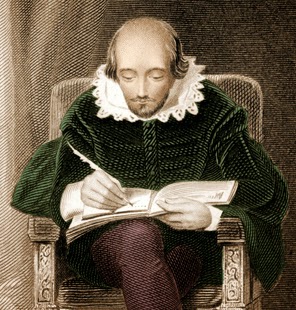
By 1597, 15 of the 37 plays written by William Shakespeare
were published. Civil records show that at this time he purchased the
second largest house in Stratford, called New House, for his family. It
was a four-day ride by horse from Stratford to London, so it is believed
that Shakespeare spent most of his time in the city writing and acting
and came home once a year during the 40-day Lenten period, when the
theaters were closed.
By 1599, William Shakespeare and his business partners built their
own theater on the south bank of the Thames River, which they called the
Globe. In 1605, Shakespeare purchased leases of real estate near
Stratford for 440 pounds, which doubled in value and earned him 60
pounds a year. This made him an entrepreneur as well as an artist, and scholars believe
these investments gave him the time to write his plays uninterrupted.
Writing Style
William Shakespeare's early plays were written in the
conventional style of the day, with elaborate metaphors and rhetorical
phrases that didn't always align naturally with the story's plot or
characters. However, Shakespeare was very innovative, adapting the
traditional style to his own purposes and creating a freer flow of
words. With only small degrees of variation, Shakespeare primarily used
a metrical pattern consisting of lines of unrhymed iambic pentameter,
or blank verse, to compose his plays. At the same time, there are
passages in all the plays that deviate from this and use forms of
poetry or simple prose.
Early Works: Histories and Comedies
With the exception of Romeo and Juliet, William Shakespeare's first plays were mostly histories written in the early 1590s. Richard II, Henry VI (parts 1, 2 and 3) and Henry V
dramatize the destructive results of weak or corrupt rulers, and have
been interpreted by drama historians as Shakespeare's way of justifying
the origins of the Tudor Dynasty.
Shakespeare also wrote several comedies during his early period: the witty romance A Midsummer Night's Dream, the romantic Merchant of Venice, the wit and wordplay of Much Ado About Nothing, the charming As You Like It and Twelfth Night. Other plays, possibly written before 1600, include Titus Andronicus, The Comedy of Errors, The Taming of the Shrew and The Two Gentlemen of Verona.
Later Works: Tragedies and Tragicomedies
It was in William Shakespeare's later period, after 1600, that he wrote the tragedies Hamlet, King Lear, Othello and Macbeth.
In these, Shakespeare's characters present vivid impressions of human
temperament that are timeless and universal. Possibly the best known of
these plays is Hamlet, which explores betrayal, retribution,
incest and moral failure. These moral failures often drive the twists
and turns of Shakespeare's plots, destroying the hero and those he
loves.
In William Shakespeare's final period, he wrote several tragicomedies. Among these are Cymbeline, The Winter's Tale and The Tempest. Though graver in tone than the comedies, they are not the dark tragedies of King Lear or Macbeth because they end with reconciliation and forgiveness.
Death
Tradition has it that William Shakespeare died on his
birthday, April 23, 1616, though many scholars believe this is a myth.
Church records show he was interred at Trinity Church on April 5, 1616.
In his will, he left the bulk of his possessions to his eldest
daughter, Susanna. Though entitled to a third of his estate, little
seems to have gone to his wife, Anne, whom he bequeathed his
"second-best bed." This has drawn speculation that she had fallen out of
favor, or that the couple was not close. However, there is very little
evidence the two had a difficult marriage. Other scholars note that the term "second-best bed" often refers to the
bed belonging to the household's master and mistres—the marital bed—and
the "first-best bed" was reserved for guests.
William Shakespeare was baptized on April 26, 1564, in
Stratford-upon-Avon, England. From roughly 1594 onward he was an
important member of the Lord Chamberlain’s Men company of theatrical
players. Written records give little indication of the way in which
Shakespeare’s professional life molded his artistry. All that can be
deduced is that over the course of 20 years, Shakespeare wrote plays
that capture the complete range of human emotion and conflict.
Mysterious Origins
Known throughout the world, the works of William Shakespeare
have been performed in countless hamlets, villages, cities and
metropolises for more than 400 years. And yet, the personal history of
William Shakespeare is somewhat a mystery. There are two primary sources
that provide historians with a basic outline of his life. One source is
his work—the plays, poems and sonnets—and the other is official
documentation such as church and court records. However, these only
provide brief sketches of specific events in his life and provide little
on the person who experienced those events.
Early Life
Though no birth records exist, church records indicate that a
William Shakespeare was baptized at Holy Trinity Church in
Stratford-upon-Avon on April 26, 1564. From this, it is believed he was
born on or near April 23, 1564, and this is the date scholars
acknowledge as William Shakespeare's birthday.
Located 103 miles west of London, during Shakespeare's time
Stratford-upon-Avon was a market town bisected with a country road and
the River Avon. William was the third child of John Shakespeare, a
leather merchant, and Mary Arden, a local landed heiress. William had
two older sisters, Joan and Judith, and three younger brothers,
Gilbert, Richard and Edmund. Before William's birth, his father became a
successful merchant and held official positions as alderman and
bailiff, an office resembling a mayor. However, records indicate John's
fortunes declined sometime in the late 1570s.
Scant records exist of William's childhood, and virtually none
regarding his education. Scholars have surmised that he most likely
attended the King's New School, in Stratford, which taught reading,
writing and the classics. Being a public official's child, William would
have undoubtedly qualified for free tuition. But this uncertainty
regarding his education has led some to raise questions about the
authorship of his work and even about whether or not William Shakespeare
ever existed.
Married Life
William Shakespeare married Anne Hathaway
on November 28, 1582, in Worcester, in Canterbury Province. Hathaway
was from Shottery, a small village a mile west of Stratford. William was
18 and Anne was 26, and, as it turns out, pregnant. Their first child, a
daughter they named Susanna, was born on May 26, 1583. Two years later,
on February 2, 1585, twins Hamnet and Judith were born. Hamnet later
died of unknown causes at age 11.
After the birth of the twins, there are seven years of William Shakespeare's life where no records exist.
Scholars call this period the "lost years," and there is wide
speculation on what he was doing during this period. One theory is that
he might have gone into hiding for poaching game from the local
landlord, Sir Thomas Lucy. Another possibility is that he might have
been working as an assistant schoolmaster in Lancashire. It is generally
believed he arrived in London in the mid- to late 1580s and may have
found work as a horse attendant at some of London's finer theaters,
a scenario updated centuries later by the countless aspiring actors and playwrights in Hollywood and Broadway.
Theatrical Beginnings
By 1592, there is evidence William Shakespeare earned a
living as an actor and a playwright in London and possibly had several
plays produced. The September 20, 1592 edition of the Stationers' Register
(a guild publication) includes an article by London playwright Robert
Greene that takes a few jabs at William Shakespeare: "...There is an
upstart Crow, beautified with our feathers, that with his Tiger's heart
wrapped in a Player's hide, supposes he is as well able to bombast out
a blank verse as the best of you: and being an absolute Johannes
factotum, is in his own conceit the only Shake-scene in a country,"
Greene wrote of Shakespeare.
Scholars differ on the interpretation of this criticism, but most
agree that it was Greene's way of saying Shakespeare was reaching above
his rank, trying to match better known and educated playwrights like Christopher Marlowe, Thomas Nashe or Greene himself.

By the early 1590s, documents show William Shakespeare was a
managing partner in the Lord Chamberlain's Men, an acting company in
London. After the crowning of King James I, in 1603, the company changed
its name to the King's Men. From all accounts, the King's Men company
was very popular, and records show that Shakespeare had works published
and sold as popular literature. The theater culture in 16th century
England was not highly admired by people of high rank. However, many of
the nobility were good patrons of the performing arts and friends of
the actors. Early in his career, Shakespeare was able to attract the
attention of Henry Wriothesley, the Earl of Southampton, to whom he
dedicated his first- and second-published poems: "Venus and Adonis"
(1593) and "The Rape of Lucrece" (1594).
Churchill Forced Out of Politics
Churchill was devastated to have been forced out of politics. Although
he was still a member of Parliament, it just wasn't enough to keep such
an active man busy. Churchill went into depression and worried that his
political life was completely over.
It was during this time that Churchill learned to paint. It started as a
way for him to escape the doldrums, but like everything Churchill did,
he worked diligently to improve himself. Churchill continued to paint
for the rest of his life.
For nearly two years, Churchill was kept out of politics. Then, in July
1917, Churchill was invited back and given the position of Minister of
Munitions. In 1918, Churchill was given the position of Secretary of
State for War and Air, which put him in charge of bringing all the
British soldiers home.
A Decade in Politics and a Decade Out
The 1920s had its ups and downs for Churchill. In 1921, he was made the
Secretary of State for the Colonies but only a year later he lost his MP
seat while in the hospital with acute appendicitis.
Out of office for two years, Churchill found himself leaning again
toward the Conservative Party. In 1924, Churchill once again won a seat
as an MP, but this time with Conservative backing. Considering he had
just returned to the Conservative Party, Churchill was quite surprised
to be given the very important position of the Chancellor of the
Exchequer in the new Conservative government that same year. Churchill
held this position for nearly five years.
In addition to his political career, Churchill spent the 1920s writing his monumental, six-volume work on World War I called The World Crisis (1923-1931).
When the Labour Party won the national election in 1929, Churchill was
once again out of government. For ten years, Churchill held his MP seat,
but did not hold a major government position. However, this didn't slow
him down.
Churchill continued to write, finishing a number of books including his autobiography, My Early Life.
He continued to give speeches, many of them warning of Germany's
growing power. He also continued to paint and learned bricklaying.
By 1938, Churchill was speaking out openly against British Prime
Minister Neville Chamberlain's plan of appeasement with Nazi Germany.
When Nazi Germany attacked Poland, Churchill's fears had proved correct.
The public once again realized that Churchill had seen this coming.
After ten years out of the government, on September 3, 1939, just two
days after Nazi Germany attacked Poland, Churchill was asked to once
again become the First Lord of the Admiralty.
Churchill Leads Great Britain in WWII
When Nazi Germany attacked France on May 10, 1940, it was time for
Chamberlain to step down as Prime Minister. Appeasement hadn't worked;
it was time for action. The same day that Chamberlain resigned, King
George VI asked Churchill to become Prime Minister.
Just three days later, Churchill gave his "Blood, Toil, Tears, and Sweat" speech
in the House of Commons. This speech was just the first of many morale
boosting speeches made by Churchill to inspire the British to keep
fighting against a seemingly invincible enemy.
Churchill spurred himself and everyone around him to prepare for war. He
also actively courted the United States to join in the hostilities
against Nazi Germany. Also, despite Churchill's extreme dislike for the
communist Soviet Union, his pragmatic side realized he needed their
help.
By joining forces with both the United States and with the Soviet Union,
Churchill not only saved Britain, but helped save all of Europe from
the domination of Nazi Germany.
Falls Out of Power, Then Back in Again
Although Churchill was given credit for inspiring his nation to win
World War II, by the end of the war in Europe, many felt that he had
lost touch with the daily lives of the people. After suffering through
years of hardship, the public didn't want to go back to the hierarchical
society of pre-war Britain. They wanted change and equality.
On July 15, 1945, the election results from the national election came
in and the Labour Party had won. The following day, Churchill, age 70,
resigned as Prime Minister.
Churchill remained active. In 1946, he went on a lecture tour in the United States that included his very famous speech, "The Sinews of Peace,"
in which he warned of an "iron curtain" descending upon Europe.
Churchill also continued to make speeches in the House of Commons and to
relax at his home and paint.
Churchill also continued to write. He used this time to start his six-volume work, The Second World War (1948-1953).
Six years after resigning as Prime Minister, Churchill was again asked
to lead Britain. On October 26, 1951, Churchill began his second term as
Prime Minister of the United Kingdom.
During his second term as Prime Minister, Churchill focused on foreign
affairs because he was very worried about the atomic bomb. On June 23,
1953, Churchill suffered a severe stroke. Although the public wasn't
told about it, those close to Churchill thought he would have to resign.
Surprising everyone, Churchill recovered from the stroke and got back
to work.
On April 5, 1955, 80-year-old Winston Churchill resigned as Prime Minister due to failing health.
Retirement and Death
In his final retirement, Churchill continued to write, finishing his four-volume A History of the English Speaking Peoples (1956-1958). Churchill also continued to give speeches and to paint.
During his later years, Churchill earned three impressive awards. On
April 24, 1953, Churchill was made Knight of the Garter by Queen
Elizabeth II, making him Sir Winston Churchill. Later that same year,
Churchill was awarded the Nobel Prize in Literature. Ten years later, on
April 9, 1963, U.S. President John F. Kennedy awarded Churchill with
honorary U.S. citizenship.
In June 1962, Churchill broke his hip after falling out of a his hotel
bed. On January 10, 1965, Churchill suffered a massive stroke. After
falling into a coma, he died on January 24, 1965 at age 90. Churchill
had remained a member of Parliament until a year before his death.
Historical Importance of Winston Churchill: Winston Churchill was
a legendary orator, a prolific writer, an earnest artist, and a
long-term British statesman. Yet Churchill, who twice served the as the
Prime Minister of the United Kingdom, is best remembered as the
tenacious and forthright war leader that led his country against the
seemingly undefeatable Nazis during World War II.
Dates: November 30, 1874 -- January 24, 1965
Also Known As: Sir Winston Leonard Spencer Churchill
Overview of Winston Churchill:
The Young Winston Churchill
Winston Churchill was born in 1874 at his grandfather's home, Blenheim
Palace in Marlborough, England. His father, Lord Randolph Churchill, was
a member of the British Parliament and his mother, Jennie Jerome, was
an American heiress. Six years after Winston's birth, his brother Jack
was born.
Since Churchill's parents traveled extensively and led busy social
lives, Churchill spent most of his younger years with his nanny,
Elizabeth Everest. It was Mrs. Everest that nurtured Churchill and cared
for him during his many childhood illnesses. Churchill stayed in touch
with her until her death in 1895.
At age eight, Churchill was sent off to boarding school. He was never an
excellent student but he was well liked and known as a bit of a
troublemaker. In 1887, 12-year-old Churchill was accepted to the
prestigious Harrow school, where he began studying military tactics.
After graduating from Harrow, Churchill was accepted into the Royal
Military College, Sandhurst in 1893. In December 1894, Churchill
graduated near the top of his class and was given a commission as a
cavalry officer.
Churchill, the Soldier and War Correspondent
After seven months of basic training, Churchill was given his first
leave. Instead of going home to relax, Churchill wanted to see action;
so he traveled to Cuba to watch Spanish troops put down a rebellion.
Churchill didn't go just as an interested soldier, he made plans to be a
war correspondent for London's The Daily Graphic. It was the beginning of a long writing career.
When his leave was up, Churchill traveled with his regiment to India.
Churchill also saw action in India when fighting Afghan tribes. This
time, again not just a soldier, Churchill wrote letters to London's The Daily Telegraph. From these experiences, Churchill also wrote his first book, The Story of the Malakand Field Force (1898).
Churchill then joined Lord Kitchener's expedition in the Sudan while also writing for The Morning Post. After seeing a lot of action in the Sudan, Churchill used his experiences to write The River War (1899).
Again wanting to be at the scene of the action, Churchill managed in 1899 to become the war correspondent for The Morning Post
during the Boer War in South Africa. Not only was Churchill shot at, he
was captured. After spending nearly a month as a prisoner of war,
Churchill managed to escape and miraculously made it to safety. He also
turned these experiences into a book - London to Ladysmith via Pretoria (1900).
Becoming a Politician
While fighting in all these wars, Churchill had decided that he wanted
to help make policy, not just follow it. So when 25-year-old Churchill
returned to England as both a famous author and a war hero, he was able
to successfully run for election as a member of Parliament (MP). This
was the start of Churchill's very long political career.
Churchill quickly became known for being outspoken and full of energy.
He gave speeches against tariffs and in support of social changes for
the poor. It soon became clear that he did not hold the beliefs of the
Conservative Party, so he switched to the Liberal Party in 1904.
In 1905, the Liberal Party won the national election and Churchill was
asked to become the Under-Secretary of State at the Colonial Office.
Churchill's dedication and efficiency earned him an excellent reputation
and he was quickly promoted. In 1908, he was made President of the
Board of Trade (a Cabinet position) and in 1910, Churchill was made Home
Secretary (a more important Cabinet position).
In October 1911, Churchill was made First Lord of the Admiralty, which
meant he was in charge of the British navy. Churchill, worried about
Germany's growing military strength, spent the next three years working
diligently to strengthen the British navy.
Family
Churchill was a very busy man. He was nearly continuously writing books,
articles, and speeches as well as holding important government
positions. However, he made time for romance when he met Clementine
Hozier in March 1908. The two were engaged on August 11 of that same
year and married just a month later on September 12, 1908.
Winston and Clementine had five children together and remained married until Winston's death at age 90.
Churchill and World War I
At first, when the war began in 1914, Churchill was praised for the work
he had done behind the scenes to prepare Britain for war. However,
things quickly started to go badly for Churchill.
Churchill had always been energetic, determined, and confident. Couple
these traits with the fact that Churchill liked to be part of the action
and you have Churchill trying to have his hands in all military
matters, not only those dealing with the navy. Many felt that Churchill
overstepped his position.
Then came the Dardanelles campaign. It was meant to be a combined naval
and infantry attack on the Dardanelles in Turkey, but when things went
badly for the British, Churchill was blamed for the whole thing.
Since both the public and officials turned against Churchill after the
Dardanelles disaster, Churchill was swiftly moved out of government.
Queen Elizabeth II was born Princess Elizabeth Alexandra Mary on April 21, 1926, in London, to Prince Albert,
Duke of York (later King George VI), and Elizabeth Bowes-Lyon. She
married Philip Mountbatten, Duke of Edinburgh in 1947, became queen on
February 6, 1952, and was crowned on June 2, 1953. During her reign, she
has tried to make the British monarchy more modern and sensitive to the
public.
Born in 1926, Queen Elizabeth II was crowned head of state, when she
was just 25 years old - after the death of her father, George IV, in
1952. Queen Elizabeth is now the second longest serving British monarch
and has presided over half a century of continual change both within the
Royal Family, Britain and the Commonweath.
Elizabeth
was the eldest child of Prince Albert, the Duke of York (later George
VI) and his wife Elizabeth (later known as the Queen Mother). Her father
Prince Albert was second in line to the throne, until his elder brother
Edward VIII abdicated in 1936 - pushing the shy Prince Albert into an
unexpected role of King. King George VI rose to the challenge though he
died early in 1952.
Elizabeth was educated at home, along with her sister
Princess Margaret. During the Second World War, they were evacuated to
Balmoral and later Windsor Castle. Towards the end of the war in 1945,
Elizabeth joined the womens Royal Auxilliary Territorial Service, where
she served as a driver and mechanic. After the war, she increasingly
stepped into her role of performing public service, and made her first
overseas trip to South Africa in 1947. Shortly before her 21st birthday,
she said:
"I declare before you all that my whole life, whether it
be long or short, shall be devoted to your service and the service of
our great imperial family to which we all belong."
In
1947, she married Prince Phillip of Greece and Denmark in a ceremony at
Westminster; they had known each other for several years. Some where
opposed to the union because of his foreign ties, but this was overcome
by his service in the Royal Navy. They have been happily married for
over 65 years, and their relationship is a source of mutual strength,
even if Prince Phillip has a reputation for letting slip the odd
colourful remark about foreigners. Elizabeth gave birth to their first
child in 1948 - the future Prince Charles. They had four children in total (Charles, Anne, Andrew, Edward)
In
1952, her father, George VI passed away and Queen Elizabeth was crowned
to widespread enthusiasm. Her coronation set TV records around the
globe, and it appeared to usher in a new era for the monarchy and
British Commonwealth. News of Edmund Hilary reaching the peak of Mt
Everest were delayed to co-incide with her coronation. It appeared a
symbolic end to the post-war austerity.
The 1950s could be seen as the golden age for the Queen. Deference
and respect to the Royal family were still high, and the young Elizabeth
looked like the fairytale Princess. However, over the next few decades,
widespread social change saw a decline in traditional attitudes to the
monarchy. Also the new era of TV and intense media scrutiny led to many
unfavourable headlines as her children were caught up in marital
problems and related scandals.
Yet, there were still high points for the Royal Family, such as her
'Silver Jubiliee' in 1977 and the wedding of Prince Charles and Lady
Diana in 1981. By the 1990s, the media had a widespread fascination with
Princess Diana,
but as their marriage broke down, the Queen was increasingly perceived
as being out of touch. In 1992, she famously declared the year to be her
'annus horribilus'
1992 is not a year on which I shall look back with undiluted
pleasure. In the words of one of my more sympathetic correspondents, it
has turned out to be an 'Annus Horribilis'. (Christmas address)
- With media headlines dominated by the marriage breakup of Charles
and Diana, a fire in Windsor, and other criticisms. In 1996, Princess
Diana died in a car crash, and temporarily there was public dismay as
the Queen appeared distant and refused to fly flag at half mast. But,
after the Queen later expressed admiration for Princess Diana the
hostility evaporated. Nevertheless, the relationship between Princess
Diana and the Queen were best described as being 'cool'.
The
Queen placed great emphasis on her job as uniting the Commonwealth - a
difficult job in the post war period as de-colonisation led to many
differing problems. However, the Queen usually received widespread
acclaim, and many say she was a real unifying presence at the
Commonwealth meetings. In a speech at the United Nations, in 2010 she
spoke of the importance of countries working together:
In tomorrow's world we must all work together as hard as ever, if we're truly to be United Nations
After the difficulties of the 1990s, the 2000s saw a resurgence in
her popularity as the Royal Family put many difficulties behind them,
and they were able to celebrate good news. If 1992 was her annus
horribilus, 2012, was perhaps her annus mirabilis. Firstly, in April, Prince William
married Kate Middleton to widespread public support. Then in summer,
her golden jubilee was widely celebrated and popular despite the wet
weather. Finally in July 2012, she took part in the opening ceremony of
the London Olympics - which was a huge global sucess.
Despite nearing the age of 81 she appears remarkably mobile, and shows no sign of passing the throne to Charles early.